
The future belongs to learners who can think critically, solve problems, adapt to change, collaborate with others, and turn ideas into action. While traditional classroom learning provides an important foundation, students also need opportunities to apply their knowledge in practical situations.
This is where experiential learning becomes meaningful.
Experiential learning is an educational approach in which students learn through hands-on activities, experiments, projects, exploration, observation, and reflection. Instead of simply memorising information, students actively participate in the learning process, helping them connect theoretical concepts with real-world experiences.
As education continues to evolve, experiential learning can help students develop the skills they need to navigate an increasingly complex and technology-driven world.
What Is Experiential Learning?
Experiential learning is learning through experience. It allows students to explore concepts, test ideas, solve challenges, and reflect on what they discover.
For example, instead of only reading about plant growth in a textbook, students can plant seeds, observe changes, record their findings, and understand the conditions required for healthy growth.
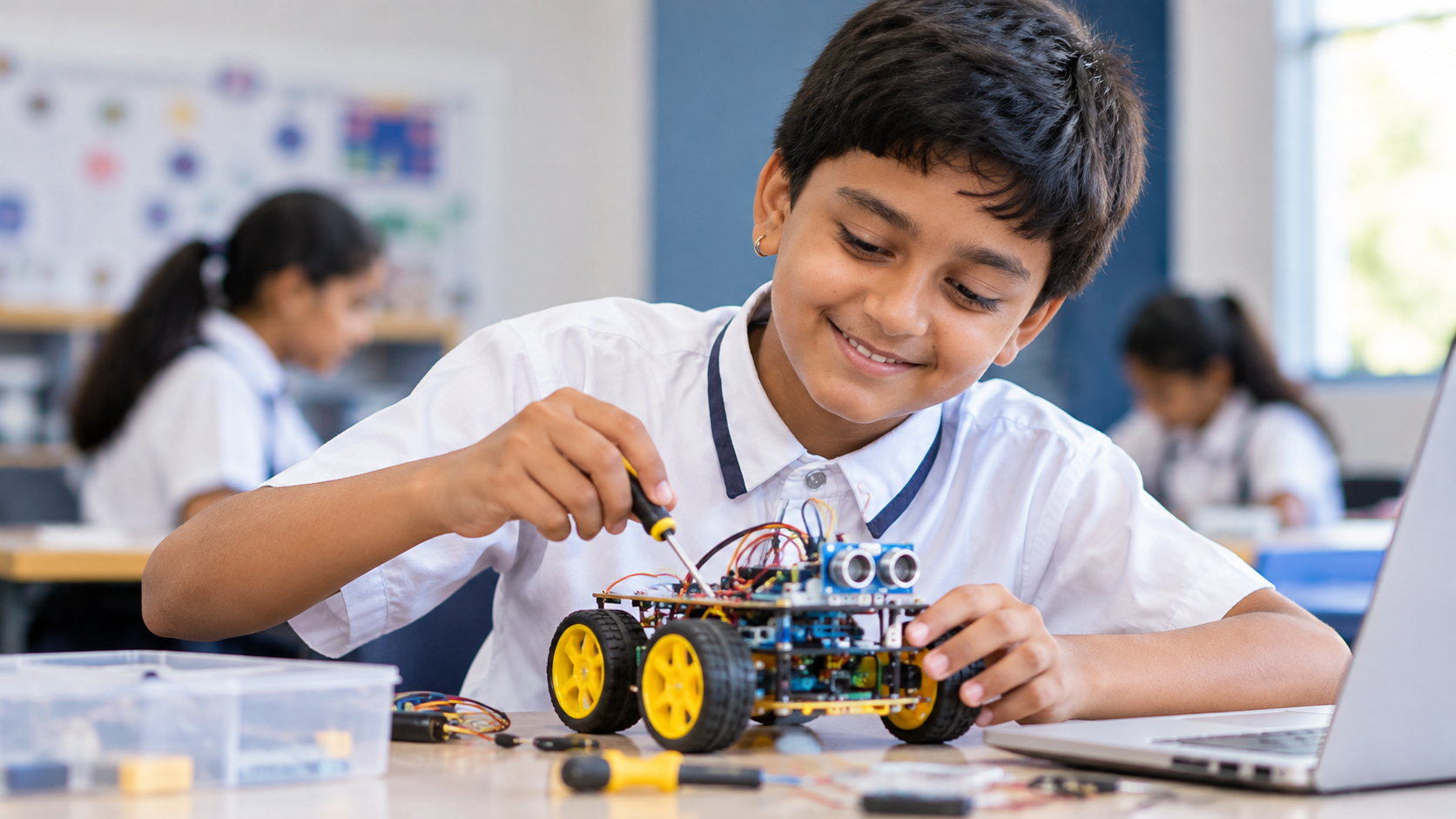
Similarly, building a simple robot can help students explore concepts related to science, technology, engineering, and mathematics while developing logical thinking and problem-solving abilities.
These experiences make learning more interactive, practical, and connected to everyday life.
The goal is not to replace classroom teaching but to complement it with meaningful opportunities to apply knowledge.
1. Develops Critical Thinking and Problem-Solving Skills
The future will require students to evaluate information, understand problems, consider different possibilities, and make informed decisions.
Experiential learning provides opportunities to practise these abilities.
When students participate in experiments, projects, and real-world activities, they encounter questions that do not always have immediate answers. They must observe situations, identify challenges, explore possible solutions, and evaluate their results.
For example, students designing a model bridge may need to determine how different materials and structures affect its strength and stability.
Through this process, they learn to analyse information, test assumptions, learn from mistakes, and improve their approach.
These experiences can help students develop a more thoughtful and systematic approach to problem-solving.
2. Encourages Creativity and Innovation
Creativity is not limited to drawing, painting, or artistic expression. It also involves generating ideas, exploring alternatives, and finding new ways to solve problems.
Experiential learning encourages students to move beyond memorised answers and explore different possibilities.
Activities such as model-making, design challenges, robotics, storytelling, and project-based learning allow students to experiment with their ideas and discover alternative solutions.
For example, when students are asked to design a useful product using everyday materials, they must imagine possibilities, plan their approach, test their ideas, and refine their designs.
Such activities can nurture curiosity, originality, and a willingness to explore new approaches.
3. Builds Collaboration and Communication
In many real-world situations, success depends on working effectively with other people.
Experiential learning often includes group projects, team challenges, collaborative experiments, and shared responsibilities.
Students learn to express their ideas, listen to different perspectives, divide tasks, manage disagreements, and work towards a common goal.
Consider a group project in which students design a sustainable school garden. One student may research suitable plants, another may plan the layout, and others may calculate material requirements or document the process.
Completing the project requires communication, coordination, and shared decision-making.
These experiences help students practise interpersonal skills that are valuable in education, professional environments, and everyday life.
4. Strengthens Adaptability and Resilience
Not every experiment produces the expected result. Some projects require multiple attempts, while others reveal that the original plan needs to change.
These moments can become valuable learning opportunities.
When students are encouraged to examine mistakes, understand what went wrong, and try a different approach, they learn that challenges are part of the learning process.
For example, a student building a working model may discover that the design does not function as expected. Instead of abandoning the project, the student can investigate the problem, adjust the design, and test it again.
This process can help students develop patience, flexibility, and confidence in approaching unfamiliar situations.
Experiential learning encourages students to focus not only on the final result but also on the lessons gained along the way.
5. Connects Classroom Knowledge With Real-World Applications
Students often understand concepts more clearly when they can see how those concepts apply beyond the classroom.
Experiential learning creates opportunities to connect academic knowledge with practical situations.
Mathematics can become more meaningful through budgeting, measurement, and construction activities. Science concepts can be explored through experiments and environmental observations. Language skills can be strengthened through presentations, storytelling, interviews, and collaborative projects.
For example, students studying environmental sustainability might investigate water usage, observe waste management practices, or develop ideas for reducing resource consumption.
These activities help students understand how different subjects connect and how knowledge can be applied to practical challenges.
6. Introduces Students to Technology and Digital Thinking
Technology continues to influence how people learn, communicate, create, and work.
Students benefit from opportunities to understand technology through active exploration rather than passive consumption alone.
Activities involving coding, robotics, digital design, and technology-supported projects can introduce students to logical reasoning, sequencing, experimentation, and computational thinking.
For example, students creating a simple coding project must organise instructions, identify errors, test outcomes, and improve their work.
These activities can help students develop a foundation for understanding digital tools and technological systems.
However, the purpose of technology-enabled learning should extend beyond using devices. Students should also learn to think independently, evaluate information, create responsibly, and understand the problems technology can help solve.
7. Encourages Curiosity, Independence, and Lifelong Learning
Future careers and technologies will continue to change. Students therefore need the ability to ask questions, seek information, explore new subjects, and continue learning throughout their lives.
Experiential learning encourages curiosity by allowing students to investigate questions and discover answers through guided exploration.
Activities such as nature observation, scientific experiments, independent projects, and creative challenges give students opportunities to take an active role in learning.
Instead of always waiting for instructions, students can learn to identify questions, explore possibilities, and reflect on their findings.
With appropriate guidance, these experiences can strengthen independence, initiative, and a willingness to learn beyond the classroom.
8. Develops Decision-Making and Responsibility
Many practical activities require students to make choices and understand the consequences of those choices.
During a project, students may need to select materials, organise their time, allocate resources, prioritise tasks, and evaluate different approaches.
For example, a group planning a small school sustainability project may need to decide which materials to use, how to distribute responsibilities, and how to measure the results.
Such activities help students practise making decisions, taking responsibility, and considering the effects of their actions.
These skills are valuable in academic life and can support students as they gradually take on greater responsibilities.
Experiential Learning vs Traditional Learning
Both traditional classroom teaching and experiential learning can contribute to effective education. They serve complementary purposes.
| Aspect | Traditional Classroom Learning | Experiential Learning |
|---|---|---|
| Learning approach | Often focuses on structured explanations and instruction | Emphasises experience, exploration, and application |
| Student participation | May involve listening, reading, discussion, and exercises | Often involves practical activities, experimentation, and projects |
| Knowledge application | Concepts may initially be learned through explanations and examples | Concepts are explored through practical situations |
| Problem-solving | Students may solve defined questions and exercises | Students may investigate open-ended challenges |
| Collaboration | Depends on classroom activities | Often includes teamwork and shared projects |
| Reflection | Can include reviewing lessons and assessments | Can include analysing experiences, mistakes, and outcomes |
| Main purpose | Builds foundational knowledge and understanding | Helps students apply knowledge and develop practical skills |
The most effective learning environments can combine both approaches. Strong foundational knowledge gives students the understanding they need, while practical experiences provide opportunities to apply and extend that knowledge.
Examples of Experiential Learning Activities That Build Future Skills
Experiential learning can take many forms, depending on students' ages, interests, learning objectives, and available resources.
| Activity | What Students Do | Skills They Can Practise |
|---|---|---|
| Robotics projects | Build, test, and improve simple robotic models | Logical thinking, problem-solving, creativity |
| Science experiments | Form questions, test ideas, and observe results | Critical thinking, observation, analysis |
| Gardening and organic farming | Plant seeds, monitor growth, and understand natural processes | Responsibility, patience, environmental awareness |
| Team sports | Practise, coordinate, and work towards shared goals | Collaboration, discipline, communication |
| Maker-space projects | Design and create useful objects | Innovation, planning, practical problem-solving |
| Coding activities | Create instructions and debug simple programmes | Computational thinking, persistence, logical reasoning |
| Outdoor exploration | Observe surroundings and investigate questions | Curiosity, observation, adaptability |
| Group presentations | Research topics and communicate findings | Communication, collaboration, confidence |
| Sustainability projects | Identify environmental challenges and explore solutions | Decision-making, responsibility, problem-solving |
| Creative design challenges | Develop, test, and improve original ideas | Creativity, experimentation, resilience |
The value of these activities depends on how they are designed, guided, and connected to clear learning objectives.
Simply participating in an activity does not automatically develop a particular skill. Students benefit when they have opportunities to think, make decisions, receive feedback, and reflect on their experiences.
How Can Schools Make Experiential Learning More Effective?
Schools can make experiential learning more meaningful by connecting practical activities with educational goals.
1. Start With a Clear Learning Objective
Every activity should have a purpose. Students should understand what they are exploring and which concepts or skills they are expected to practise.
2. Encourage Questions and Exploration
Give students opportunities to ask questions, investigate possibilities, and develop their own approaches within appropriate boundaries.
3. Allow Students to Learn From Mistakes
Mistakes can provide useful information. Encourage students to understand what happened, evaluate their decisions, and try alternative solutions.
4. Connect Activities With Classroom Concepts
Help students recognise how practical experiences relate to mathematics, science, language, technology, social studies, and other subjects.
5. Include Reflection and Discussion
After an activity, ask students what they discovered, which challenges they encountered, what they would change, and how they might apply their learning elsewhere.
6. Provide Guidance and Feedback
Teachers play an important role in helping students interpret experiences, develop understanding, and improve their skills.
Experiential learning works best when practical exploration is supported by thoughtful instruction, appropriate resources, and opportunities for reflection.
How Experiential Learning Prepares Students for the Future
The future will require more than the ability to remember information. Students will also need to understand complex situations, communicate ideas, collaborate with others, adapt to change, and apply knowledge in unfamiliar contexts.
Experiential learning can provide opportunities to practise these abilities in meaningful situations.
Through experiments, projects, design challenges, team activities, and practical exploration, students can develop a stronger understanding of how learning connects to the world around them.
These experiences can also help students recognise their interests, explore different ways of thinking, and build confidence in approaching new challenges.
The aim is not to predict exactly which skills every student will need in the future. It is to help students develop the knowledge, habits, and capabilities that support continued learning and thoughtful participation in a changing world.
Frequently Asked Questions
What is experiential learning in simple words?
Experiential learning is learning by doing, exploring, experimenting, and reflecting. It helps students connect ideas and concepts with practical experiences.
How does experiential learning build future skills?
It gives students opportunities to practise critical thinking, creativity, communication, collaboration, adaptability, and problem-solving through meaningful activities and projects.
What are examples of experiential learning in schools?
Examples include science experiments, robotics, coding, gardening, sports, maker-space projects, outdoor exploration, group assignments, and sustainability activities.
Is experiential learning better than traditional learning?
Both approaches have value. Traditional teaching helps students develop foundational knowledge, while experiential learning allows them to apply and extend that knowledge through practical experiences. Combining the two can create a more complete learning experience.
What role do teachers play in experiential learning?
Teachers design meaningful activities, guide exploration, ask questions, provide feedback, connect experiences to academic concepts, and help students reflect on what they learn.
Can experiential learning help students become independent learners?
It can support independence by encouraging students to ask questions, investigate problems, make decisions, and reflect on their experiences. The degree of independence depends on the activity, the student's development, and the guidance provided.
Conclusion
Experiential learning creates opportunities for students to move beyond memorising information and begin applying knowledge in meaningful ways.
Through practical activities, exploration, collaboration, and reflection, students can practise the critical thinking, creativity, communication, adaptability, and problem-solving skills that support their continued development.
When schools combine strong academic foundations with purposeful, hands-on experiences, learning becomes more connected to the world students are preparing to enter.
Because preparing students for the future is not only about what they know today. It is also about how they think, explore, adapt, and continue learning tomorrow.
Ready to Give Your Child a Future-Ready Education?
See if SSI Ambaji's nature-based, innovation-first CBSE program is the right fit for your child. Admissions are open for boarding, residential, and day school.