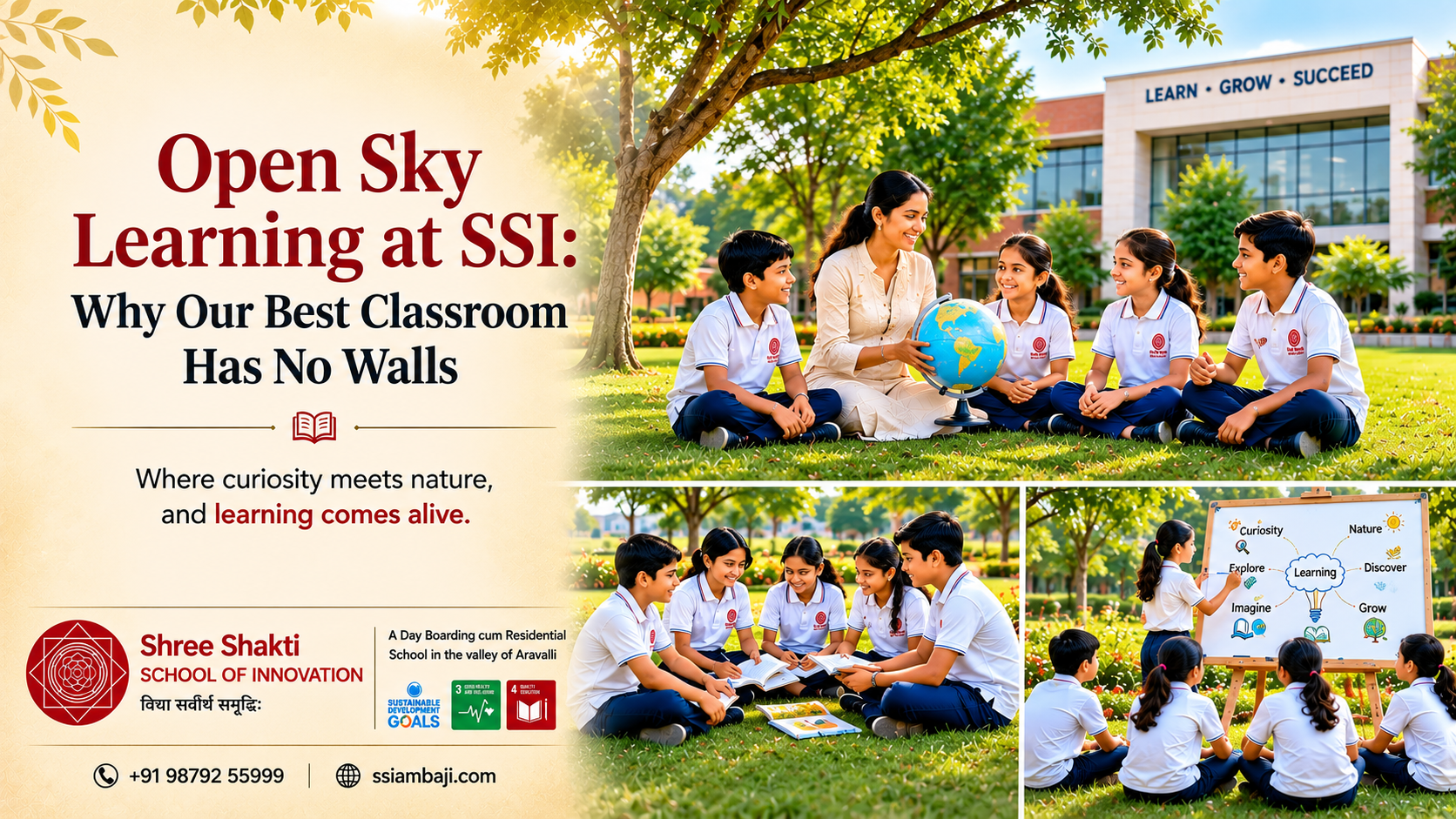
Walk through our campus on any weekday morning and you will find something unusual: classes happening under trees.
A science lesson in Oxyzone Park, students sketching leaf structures from living plants. A mathematics class measuring the shadow of a flagpole to understand ratios. A language class writing monsoon poems with the actual monsoon overhead. At Shree Shakti School of Innovation, we call this Open Sky Learning, and it is one of the defining pillars of our pedagogy. Discover more about why nature-based learning matters.
1. The Natural World as Syllabus
Our campus sits on the Ambaji–Danta highway with the Aravalli hills as its permanent backdrop. Most schools would call that scenery. We call it curriculum.
When a Class 3 student learns about pollination, she does not look at a diagram — she watches a bee work a flower ten feet from her mat and records what she sees in her field journal. When Class 6 studies soil types, they hold Aravalli soil in their hands, compare it with garden compost, and test which drains faster. The concept and the reality arrive together, and knowledge learned this way does not evaporate after the examination. We also explore these themes during our annual 3-day nature camp at SSI.
2. What the Research — and Our Eyes — Tell Us
Educators worldwide have documented what outdoor learning does for children: better attention, lower stress, stronger retention and greater physical activity. We see the same pattern daily without a research paper. A restless child indoors becomes an absorbed observer outdoors. Questions multiply in the open air. Read more on moving from screen time to green time.
There is also a quieter effect. Children who study nature begin to protect it. Our Van Mahotsav plantation drive, where every student adopted a sapling, works because the children already know the campus trees as classmates, not decoration. Biodiversity is pedagogy here in the most literal sense.
3. How Open Sky Learning Is Structured
Open Sky Learning at SSI is planned teaching, not an occasional picnic. Teachers map outdoor sessions to specific CBSE learning outcomes for each class. Field journals are assessed. Weather has a protocol. Indoor classrooms remain fully equipped for the work that belongs indoors — the point is choosing the right room for the lesson, and sometimes the right room has a sky for a ceiling.
The practice nurtures the Panchkosha across every layer: bodies that move (Annamaya), lungs full of clean hill air (Pranamaya), the calm that nature settles into children (Manomaya), observation-based reasoning (Vijnanmaya), and the plain happiness of learning under a tree (Anandmaya).
4. Vice Principal's Message
"Children spend their childhood being told to sit still and look at a board. We ask a different question: what would they learn if the world itself were the board? The answer, every single week, astonishes us."
— Vice Principal, Shree Shakti School of Innovation
5. See It With Your Own Eyes
Photographs flatten what this campus feels like. Parents considering SSI are warmly invited to visit during a school day through our Campus Experience Program and sit in on an open-sky class. Watch the children. Their faces are our best brochure. You can also view our campus gallery for a glimpse of daily life.
Explore how holistic education helps children succeed in life → Holistic Education
Frequently Asked Questions
What is the most important factor when choosing a school for my child?
The most important factor is finding a complete alignment between the school's educational philosophy and your child's individual learning needs. Beyond academic scores, evaluate safety, teacher-student ratios, holistic co-curricular opportunities, physical infrastructure, and whether the environment encourages curiosity and emotional well-being.
Why is CBSE preferred by many parents in India?
CBSE is widely preferred because it offers a standardized national curriculum aligned with major competitive entrance examinations like JEE, NEET, and CUET. Its focus on application-based learning, conceptual clarity, and national transferability makes it ideal for holistic skill development and future academic success.
How does student-teacher ratio affect my child's learning?
A low student-teacher ratio ensures that educators can provide personalized attention, adapt teaching methods to individual learning styles, identify academic or emotional challenges early, and foster strong mentor-student relationships. It prevents children from feeling overlooked in crowded classrooms.
What safety features should parents verify during a school visit?
Parents should check for gated entry points with verified visitor protocols, 24/7 CCTV surveillance in common areas, background-checked staff, secure perimeter fencing, clean sanitation facilities, multi-stage drinking water purification, and an operational campus medical unit with trained first-aid personnel.
How can parents schedule a campus visit to SSI Ambaji?
Parents can easily schedule a campus visit by reaching out directly to the SSI Ambaji admissions office via their official website contact page. Visiting the campus allows families to explore the nature-based environment, tour facilities, interact with educators, and experience student life firsthand.
Ready to visit?
Experience our serene campus and holistic learning environment firsthand.
Ready to Give Your Child a Future-Ready Education?
See if SSI Ambaji's nature-based, innovation-first CBSE program is the right fit for your child. Admissions are open for boarding, residential, and day school.